Why Your Car Insurance Went Up Even Though You Didn’t Have a Single Claim — And 5 Ways to Bring It Back Down
You renewed your auto policy, opened the bill, and did a double take.
It went up — again. And you haven’t had a ticket in years. No accidents. No claims. Nothing. You’ve been a model driver, and your insurer rewarded you with a higher bill anyway.
You’re not crazy, and you’re not alone. Nearly two-thirds of American drivers saw their rates increase in the past 12 months. Most are scratching their heads wondering why.
Here’s the truth no one tells you: your premium has almost nothing to do with your driving lately. The forces pushing rates up are largely out of your hands — but knowing what they are puts you in a much better position to fight back. Let’s break it down.
The Real Reasons Your Rate Went Up (Hint: It’s Not You)
1. Your Car Costs a Fortune to Fix Now
Modern vehicles are technological marvels — and a nightmare to repair. Bumpers are packed with radar sensors. Windshields have lane-assist cameras built in. Side mirrors have blind-spot monitors. A fender-bender that used to cost $800 to fix can now run $4,000 or more once you factor in recalibrating all that technology.
The numbers are staggering. The cost of vehicle repairs and maintenance jumped more than 36% between 2021 and 2025, with labor and bodywork costs each rising over 13%. Every time someone files a claim anywhere in the country, insurers are paying out more — and they spread that cost across all policyholders at renewal time.
2. New and Used Cars Are Worth a Lot More
If your car gets totaled, the insurance company has to cut you a check for its replacement value. The problem? The average used car today costs about 23% more than it did in 2019. That means every total-loss claim is a bigger payout than it used to be. Bigger payouts mean higher premiums for everyone — including you, the driver who hasn’t had a single claim.
3. Tariffs Made Parts Even More Expensive
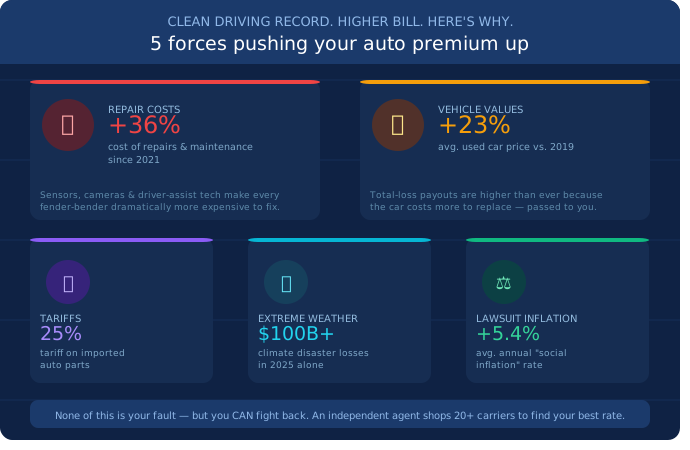
Here’s a 2025-2026 wrinkle most people don’t realize has hit their insurance bill: tariffs. A 25% tariff on imported auto parts drove repair costs higher across the board. Insurance companies saw this coming and filed for rate increases with state regulators — and many of those approved increases are hitting drivers right now as policies renew throughout 2026.
4. Severe Weather Is Hammering Insurers Nationally
Even if you live nowhere near a wildfire or hurricane zone, catastrophic weather losses affect what you pay. In 2025 alone, weather and climate disasters cost the insurance industry more than $100 billion — and that was a year without a major hurricane making U.S. landfall. Hailstorms, flooding, and wildfires destroyed hundreds of thousands of vehicles. Those losses get pooled across the entire country’s policyholders.
5. “Billboard Attorneys” and Lawsuit Abuse
You’ve seen the ads. Personal injury attorneys plastered across highway billboards, TV commercials, and social media, urging anyone in a fender-bender to “call before you talk to your insurer.” This aggressive legal marketing has contributed to what the industry calls social inflation — a surge in litigated claims, inflated settlements, and nuclear jury verdicts that far exceed actual damages. The Insurance Information Institute’s Mark Friedlander points to this directly as a driver of ongoing rate increases. Insurers pay these inflated settlements, then pass the cost along in the form of higher premiums across the board.
6. More Miles, More Claims
After the pandemic years of lower driving, Americans are back on the road in full force — commuting, traveling, and driving for gig work. More miles driven equals more accidents, more claims, and more pressure on insurers to raise rates to stay solvent.
So How Much Are We Actually Talking About?
The jump over the past few years has been historic. The average annual auto insurance premium was around $1,127 in 2022. By 2025, it had climbed to $2,539 — more than double in just three years. The national average for full coverage today sits around $2,637 per year.
The good news: the worst of the increases appears to be behind us. Rate hikes have moderated significantly heading into 2026, and several major insurers — including State Farm — have actually lowered rates in some states. But “moderating increases” still means most drivers are paying more than they were two years ago, and the savings aren’t coming automatically.
You have to go get them.
5 Ways to Bring Your Rate Back Down
Here’s where your agent earns their keep. These aren’t gimmicks — they’re legitimate strategies that can make a real dent in what you pay.
✅ 1. Shop Your Policy (The Right Way)
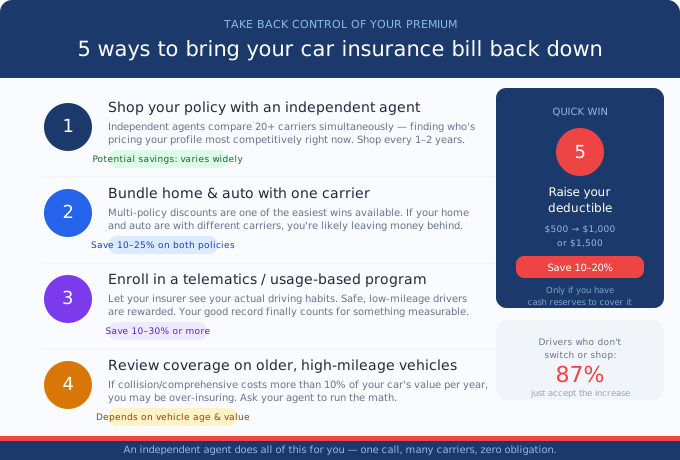
The single most powerful thing you can do is compare quotes across multiple carriers. This doesn’t mean jumping carriers every six months — experts now caution that frequent switching can actually flag you as an undesirable customer with some underwriters. But shopping every two to three years, or any time you get a significant rate increase, is smart financial practice.
An independent insurance agent does this for you. Unlike a captive agent who only has one company’s rates to offer, an independent agent can run your information through dozens of carriers simultaneously and find who is actually pricing your profile competitively right now. Carriers gain and lose appetite for certain driver profiles all the time — what was most expensive last year might be the cheapest today.
✅ 2. Bundle Your Home and Auto
This one is simple and consistently delivers. Most insurers offer significant discounts — often 10% to 25% — when you bundle your auto policy with a homeowners, renters, or condo policy. If your home and auto are currently with different companies, you may be leaving serious money on the table every single year.
The discount makes sense from the insurer’s perspective: you’re less likely to leave, they save on acquisition costs, and they have a more complete picture of your risk profile. You win too.
✅ 3. Ask About a Telematics / Usage-Based Program
Nearly every major insurer now offers some version of a telematics program — a small device or smartphone app that monitors your actual driving habits (speed, braking, miles driven, time of day). If you’re a safe, low-mileage driver, these programs can deliver discounts of 10% to 30% or more.
Think of it this way: you’ve already proven you’re a responsible driver by not having claims. A telematics program lets you show your insurer that, rather than just telling them — and get paid for it in the form of lower premiums.
One important note: review the program’s terms before enrolling. Some programs can raise your rate if the data doesn’t look favorable. Your agent can help you evaluate which programs are structured to reward good drivers without penalizing you.
✅ 4. Review Your Coverage on Older Vehicles
If you’re paying for comprehensive and collision coverage on an older vehicle with significant miles, it’s worth doing the math. A good rule of thumb: if the annual cost of collision and comprehensive coverage exceeds 10% of your vehicle’s current market value, you may be over-insuring that car.
For example, if your car is worth $5,000 and you’re paying $600 a year for collision alone with a $500 deductible, you’re spending 12% of the car’s value annually for coverage that would only net you $4,500 in the best-case scenario. Dropping those coverages on the right vehicle — while making sure you have strong liability limits on everything else — can provide meaningful savings.
This is a conversation worth having with your agent rather than doing alone, because the wrong coverage cut can leave you seriously exposed.
✅ 5. Increase Your Deductible Strategically
Raising your deductible from $500 to $1,000 or even $1,500 can lower your premium noticeably — often by 10% to 20% depending on your carrier and state. The logic: you’re agreeing to self-insure a larger portion of smaller claims, and the insurer rewards you with a lower rate.
The key word is strategically. This only makes sense if you have the cash reserves to cover that higher deductible if you need to use it. A 27% of drivers say they couldn’t afford their current deductible — don’t put yourself in that position. But if you have three months of emergency savings and a clean driving record, a higher deductible can be a smart way to lower your monthly costs while keeping the catastrophic coverage that really matters intact.
The Bottom Line
Your rate went up because the entire insurance ecosystem absorbed a massive wave of higher costs — vehicles, parts, lawsuits, and weather — and carriers are still working through the ripple effects. None of that is your fault. But the solution isn’t to just accept it and move on.
The drivers getting the best rates right now are the ones actively managing their policies: shopping across carriers, bundling where they can, taking advantage of telematics, and having real conversations with an agent who knows how to advocate for them.
That’s exactly what we’re here to do.
Ready to find out if you’re overpaying? Give us a call or shoot us a message — we’ll run a no-obligation comparison across our carriers and see what the market looks like for your specific profile right now. Most clients are surprised by what we find.
DSB Insurance Agency, LLC | www.DSBinsurance.com/quotes | myagent@dsbinsurance.com | 740-656-5119
Licensed in Ohio
Sources: Insurance Information Institute (Triple-I), The Zebra 2026 State of Insurance Auto Report, CarInsurance.com 2026 Consumer Survey, InsuredBetter, Freeway Insurance Auto Insurance Pricing Report, Aftermarket Matters.
📚 Trusted Industry Sources
Insurance Information Institute (Triple-I) — Auto Insurance | https://www.iii.org/article/what-determines-the-price-of-an-auto-insurance-policy | The industry’s leading source for consumer education on what drives your premium.
The Zebra — 2026 State of Auto Insurance Report | https://www.thezebra.com/state-of-insurance/auto/2026/ | Data on rates across all 50 states, updated annually.
-Ohio Department of Insurance — Consumer Resources | https://insurance.ohio.gov/consumer | Ohio-specific rights, complaint filing, and rate comparison tools for Ohio drivers.
U.S. Bureau of Labor Statistics — Consumer Price Index: Auto Insurance | https://www.bls.gov/cpi/ | The government source behind the “nearly 20% year-over-year” premium stat cited in this post.
NHTSA — Vehicle Safety & Technology | https://www.nhtsa.gov | Background on why modern vehicle safety tech drives up repair costs.
📚 Internal Links: From DSB Insurance — Serving Chillicothe & the Ohio area.
Get your auto policy reviewed or re-shopped: → Auto Insurance in Chillicothe, OH — DSB Insurance Agency | https://www.dsbinsurance.com/personal/auto-insurance/ | We compare rates across multiple top-rated Ohio carriers — at no cost to you.
Bundle and save on home + auto: → Homeowners Insurance in Chillicothe, OH — DSB Insurance Agency | https://www.dsbinsurance.com/personal/homeowners-insurance/ *Bundling home and auto with one carrier is one of the fastest ways to lower both bills.*
See everything we cover:** → Personal Insurance — DSB Insurance Agency | https://www.dsbinsurance.com/personal/ | Auto, home, life, farm, and more — all under one independent agency roof.*
Ready to talk? Reach us directly: → Contact DSB Insurance Agency | https://www.dsbinsurance.com/contact/ → Start a Quote Online –> https://www.dsbinsurance.com/quotes