
How to Drive Safely on Ice and Snow: Complete Winter Driving Guide for Ohio
Every winter, the same scene plays out on Ohio roads: cars in ditches, fender benders at intersections, and multi-car pileups on highways. In Ross County alone, winter weather accounts for over 30% of all traffic accidents between November and March.
At DSB Insurance Agency in Chillicothe, we see the aftermath of winter driving accidents every year – both the financial cost and, more importantly, the human cost. While we can help you file a claim after an accident, we’d much rather help you avoid one in the first place.
This comprehensive guide will teach you everything you need to know about driving safely in Ohio’s winter weather, from basic techniques to advanced recovery maneuvers, plus exactly what to keep in your car in case the worst happens.
Because the best insurance policy is the one you never have to use.
Understanding Ohio Winter Road Conditions
Before we dive into driving techniques, you need to understand what you’re up against on Ohio roads.
Types of Winter Road Conditions
Black Ice (Most Dangerous)
- Thin, transparent layer of ice on pavement
- Looks like wet road, but it’s frozen
- Forms when temperatures hover around freezing (28-34°F)
- Most common on bridges, overpasses, and shaded areas
- Nearly impossible to see until you’re on it
- Zero traction – like driving on glass
Packed Snow
- Snow compressed by traffic into hard, slick surface
- Provides some traction, but very slippery
- Common on side streets and rural roads
- Can hide ice underneath
Slush
- Wet, partially melted snow
- Causes hydroplaning
- Reduces visibility (spray from other vehicles)
- Can freeze into ice when temperatures drop
Fresh Snow
- Better traction than ice, but still dangerous
- Hides road features and hazards
- Reduces visibility
- Depth matters – 2″ is very different from 6″
Freezing Rain
- Most dangerous winter weather condition
- Everything becomes coated in ice
- Roads, power lines, trees all affected
- Avoid driving if possible during freezing rain
Where Ice Forms First in Ohio
High-Risk Areas:
- Bridges and overpasses – Cold air circulates above and below, causing faster freezing
- Shaded areas – Trees block sun, preventing ice from melting
- Intersections – Stop-and-go traffic polishes snow into ice
- Hills and curves – Especially dangerous when icy
- Near bodies of water – Higher humidity creates more ice
- North-facing roads – Less sun exposure
In Chillicothe and Ross County:
- US Route 23 bridges over Paint Creek
- Route 50 overpasses
- Shaded sections of Route 104
- Rural roads without salt treatment
- Hills on back roads
Ohio Weather Patterns That Create Dangerous Driving
Freeze-Thaw Cycles: Ohio’s temperatures fluctuate constantly in winter. Roads melt during the day, refreeze at night, creating treacherous morning commutes.
Lake Effect (Northern Ohio): While Chillicothe doesn’t get heavy lake effect snow, we sometimes get the tail end of systems that dump snow up north.
Ice Storms: Freezing rain events can make all roads impassable. When forecasted, stay home.
Sudden Temperature Drops: Wet roads at 38°F can become skating rinks when temperature drops to 28°F in an hour.
Before You Drive: Preparation is Everything
The safest winter driving starts before you leave your driveway.
Vehicle Preparation
Tires (Most Important!)
Winter Tires vs. All-Season:
- Winter tires provide 25-50% better traction on snow/ice
- Rubber compound stays flexible in cold
- Deeper treads channel snow and slush
- Consider winter tires if you drive frequently in bad weather
All-Season Tires:
- Adequate for most Ohio winter driving
- Must have at least 4/32″ tread depth (6/32″ is better)
- Check with penny test: Insert penny into tread (Lincoln’s head down). If you can see the top of his head, replace tires.
Tire Pressure:
- Cold weather reduces tire pressure
- Check monthly in winter
- Proper inflation improves traction and handling
Fluids
Windshield Washer Fluid:
- Use winter formula (rated to -20°F or lower)
- Keep reservoir full – you’ll use a LOT in winter
- Carry extra gallon in trunk
Antifreeze:
- Check coolant level and concentration
- Should protect to at least -30°F
- Have mechanic test before winter
Oil:
- Consider switching to winter-weight oil
- Synthetic flows better in extreme cold
- Check level regularly
Battery
Cold Weather Kills Batteries:
- Have battery tested before winter (free at most auto parts stores)
- Replace if older than 4-5 years
- Clean corrosion from terminals
- Weak battery = car won’t start in cold
Lights
Visibility is Critical:
- Replace any burned-out bulbs
- Clean headlights (oxidation reduces brightness)
- Test all lights: headlights, taillights, brake lights, turn signals
Wipers
Good Wipers = Good Visibility:
- Replace wiper blades annually (before winter)
- Consider winter blades (rubber boot prevents ice buildup)
- Test washer spray pattern
Fuel
Keep Tank Above Half Full:
- Prevents fuel line freeze-up
- Ensures you have gas if stranded
- Adds weight over rear wheels (helps traction on rear-wheel drive)
Personal Preparation
Check Weather and Road Conditions
Before every winter trip:
- Check weather forecast
- Check Ohio DOT road conditions: ohgo.com
- Check traffic cameras
- Consider delaying trip if conditions are bad
Ohio Travel Advisories:
- Level 1: Roadways are hazardous with blowing and drifting snow. Use caution.
- Level 2: Roads hazardous. Only necessary travel recommended.
- Level 3: All roads closed to non-emergency personnel. No one should be driving.
If Level 2 or 3 is declared for Ross County – STAY HOME. No destination is worth your life.
Plan Your Route
- Stick to main roads (plowed and salted first)
- Avoid hills and back roads if possible
- Know alternate routes
- Tell someone your route and expected arrival time
Allow Extra Time
- Double your normal travel time in snow
- Triple it on ice
- Leave early – rushing causes accidents
- If you’re late, you’re late. Better than crashing.
Winter Driving Techniques: How to Stay Safe
Now let’s cover the techniques that will keep you safe on winter roads.
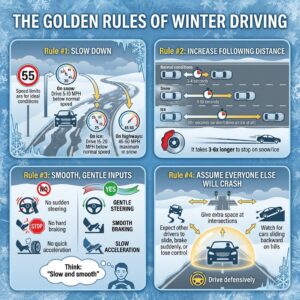
The Golden Rules of Winter Driving
Rule #1: SLOW DOWN
- Speed limits are for ideal conditions
- On snow: Drive 5-10 MPH below normal speed
- On ice: Drive 15-20 MPH below normal speed
- On highways: 45-50 MPH maximum in snow
Rule #2: INCREASE FOLLOWING DISTANCE
- Normal conditions: 3-4 seconds
- Snow: 8-10 seconds
- Ice: 10+ seconds (or don’t drive on ice at all)
- It takes 3-6x longer to stop on snow/ice
Rule #3: SMOOTH, GENTLE INPUTS
- No sudden steering
- No hard braking
- No quick acceleration
- Think: “Slow and smooth”
Rule #4: ASSUME EVERYONE ELSE WILL CRASH
- Drive defensively
- Expect other drivers to slide, brake suddenly, or lose control
- Give extra space at intersections
- Watch for cars sliding backward on hills
Starting and Accelerating
From a Stop:
- Accelerate gently and slowly
- If wheels spin, ease off gas immediately
- Light pressure on gas pedal
- Higher gear can help (if manual transmission)
Getting Unstuck:
- Don’t floor the gas – makes it worse
- Rock gently back and forth (forward, reverse, repeat)
- Turn wheels side to side to find traction
- Place floor mats, cardboard, or kitty litter under drive wheels
- Last resort: Call for help
Uphill:
- Build momentum before hill (safely)
- Maintain steady speed going up
- Don’t stop partway up if possible
- If you must stop, use parking brake to prevent rolling backward
Braking on Snow and Ice
Modern Cars with ABS (Anti-Lock Brakes):
- Apply firm, steady pressure
- DO NOT pump the brakes
- Let ABS do its job (you’ll feel pulsing – that’s normal)
- Steer while braking if needed
Older Cars without ABS:
- Pump brakes gently and rapidly
- Prevents wheels from locking up
- Allows you to steer while braking
General Braking Tips:
- Start braking MUCH earlier than normal
- Brake before curves, not during
- Test brakes in empty area to learn stopping distance
- If sliding, ease off brake and reapply gently
Engine Braking:
- Downshift to slow down (manual transmission)
- Use lower gear on automatics (L, 2, or 3)
- Reduces reliance on brakes
- Especially useful on hills
Steering and Turning
Approaching Curves:
- SLOW DOWN before the curve
- Brake in straight line before turning
- Coast through curve at steady speed
- Accelerate gently coming out of curve
Turning at Intersections:
- Slow to near-walking speed
- Turn wheel slowly and smoothly
- Widen your turn if needed
- Watch for oncoming cars sliding through
Lane Changes:
- Signal early
- Check mirrors and blind spots twice
- Move slowly into lane
- Don’t change lanes on curves or hills
Hills
Going Downhill:
- Use engine braking (low gear)
- Go slowly – speed is your enemy
- Light, gentle brake taps if needed
- Never brake hard going downhill on ice
Going Uphill:
- Get momentum before hill (but don’t speed)
- Steady, gentle acceleration
- Don’t stop if you can avoid it
- If you start sliding backward, steer straight and use brakes gently
If You Get Stuck on a Hill:
- DO NOT keep trying to drive up – you’ll just dig in
- Back down slowly and carefully
- Find alternate route
- Wait for plow/salt truck
Highway Driving in Winter
Interstate Safety:
- Stay right except to pass
- Increase following distance to 10+ seconds
- Watch for ice on bridges
- Be extra cautious in high-traffic areas (ice gets polished)
- Avoid cruise control (you need full control)
Passing:
- Only pass when absolutely necessary
- Check for ice in left lane
- Pass quickly but safely
- Signal early
Truckers:
- Give semis EXTRA space
- They can’t stop quickly
- They create spray/snow clouds that blind you
- Never cut in front of trucks
What to Do If You Start to Skid
Rear-Wheel Skid (Fishtail):
- Ease off gas (don’t brake)
- Steer in direction you want to go (look where you want to go)
- Don’t overcorrect
- When car straightens, gently accelerate
Front-Wheel Skid (Understeering):
- Ease off gas
- Straighten steering wheel momentarily
- When traction returns, steer gently in desired direction
All-Wheel Skid:
- Ease off gas and brake
- Steer toward where you want to go
- Don’t make sudden movements
- Let car slow naturally
The Most Important Thing: LOOK WHERE YOU WANT TO GO, NOT AT WHAT YOU WANT TO AVOID.
Your car goes where your eyes go. Look at the road, not the ditch.
Dealing with Specific Winter Hazards
Black Ice
How to Identify:
- Road looks wet, but it’s freezing temperature
- Pavement appears darker than surroundings
- Other cars look like they’re sliding slightly
- You feel steering become very light
If You Hit Black Ice:
- DO NOT brake or steer
- Take foot off gas
- Keep steering wheel straight
- Coast until you’re past the ice
- Gently accelerate once traction returns
Avoiding Black Ice:
- Assume any bridge or overpass is icy when temp is below 35°F
- Watch for shaded areas
- Early morning and late evening are worst times
- If temperature is 32°F or below and roads look wet – it’s probably ice
Whiteout Conditions
Blowing Snow Reducing Visibility:
- Slow way down
- Turn on headlights (NOT high beams)
- Follow road lines/edge markers
- Increase following distance dramatically
- If you can’t see, pull over safely and wait
Never Stop on Highway:
- Other cars can’t see you
- Pull completely off road
- Turn on hazard lights
- Wait until visibility improves
Freezing Rain/Ice Storms
Best Advice: DON’T DRIVE
If you absolutely must:
- Drive under 20 MPH
- Avoid hills
- Avoid braking if possible (coast and engine brake)
- Triple your following distance
- Seriously consider turning around
Deep Snow
6+ Inches:
- High-clearance vehicles only
- Drive in tracks left by other vehicles
- Maintain steady speed (don’t stop)
- Watch for hidden obstacles
- Turn around if it gets too deep
What to Do If You’re in an Accident
Despite your best efforts, accidents can still happen.
Immediate Actions
1. Check for Injuries
- Your safety first
- Check passengers
- Call 911 if anyone is hurt
2. Move to Safety If Possible
- If cars are drivable and no serious injuries, move off road
- Turn on hazard lights
- Set out flares or warning triangles if you have them
- Don’t stand in traffic
3. Call Police
- Always call for winter weather accidents
- Get police report number
- Document that weather was a factor
4. Exchange Information
- Driver’s name, phone, address
- Insurance company and policy number
- Vehicle make, model, license plate
- Don’t admit fault – just exchange info
5. Document Everything
- Take photos of all vehicles
- Photo the road conditions
- Photo skid marks, debris, final positions
- Get witness names and contact info
- Note weather conditions, time, location
6. Call Your Insurance Agent
DSB Insurance: (740) 656-5119
We’ll help you:
- Start the claims process
- Understand your coverage
- Coordinate with other driver’s insurance
- Arrange for vehicle towing/rental car
Important: Weather-Related Accident Coverage
Your Auto Insurance:
- Collision coverage pays for your vehicle damage (regardless of fault)
- Comprehensive coverage for weather damage (tree falls on car, etc.)
- Liability coverage if you hit someone else
Does Weather Excuse Fault? NO. In Ohio, you’re still responsible for driving safely in weather conditions. “The road was icy” doesn’t eliminate liability.
However: Weather is a mitigating factor. Insurance companies understand winter accidents and typically don’t penalize as harshly as at-fault summer accidents.
What to Keep in Your Car for Winter Emergencies
Being prepared can save your life if you get stranded in winter weather.
Essential Emergency Kit
Must-Have Items:
Warmth:
- [ ] Heavy blanket or sleeping bag (one per person)
- [ ] Extra winter coat
- [ ] Gloves, hat, scarf
- [ ] Hand warmers (chemical heat packs)
- [ ] Emergency “space blanket” (reflective mylar)
Food and Water:
- [ ] Bottled water (several bottles)
- [ ] Non-perishable snacks (granola bars, nuts, dried fruit)
- [ ] High-calorie energy bars
- [ ] Hard candy (keeps mouth from getting dry)
Light and Communication:
- [ ] Flashlight with extra batteries
- [ ] Headlamp (hands-free)
- [ ] Phone charger (car adapter AND portable battery pack)
- [ ] Whistle (to signal for help)
- [ ] Road flares or LED warning lights
First Aid:
- [ ] Basic first aid kit
- [ ] Any necessary medications
- [ ] Extra prescription glasses (if you wear them)
Tools and Supplies:
- [ ] Ice scraper and snow brush
- [ ] Small shovel (collapsible is fine)
- [ ] Bag of sand, salt, or kitty litter (for traction)
- [ ] Jumper cables
- [ ] Tow rope or strap
- [ ] Multi-tool or knife
- [ ] Duct tape
- [ ] Lighter or waterproof matches
Vehicle Supplies:
- [ ] Extra windshield washer fluid
- [ ] Oil and other fluids
- [ ] Tire gauge
- [ ] Fix-a-flat or tire repair kit
- [ ] Reflective vest
Optional But Recommended:
- [ ] Portable jump starter (battery pack)
- [ ] Small battery-powered radio
- [ ] Books or cards (for waiting)
- [ ] Toilet paper and wet wipes
- [ ] Small trash bags
- [ ] Cash (ATMs might not work in power outage)
Winter Car Kit Storage
Where to Keep It:
- Large items in trunk
- Smaller items under seat or in glove box
- Keep blanket accessible (not buried in trunk)
- Phone charger in front console
Check Your Kit:
- Monthly during winter
- Replace expired food
- Test flashlights
- Ensure everything is actually in the car
What to Do If You Get Stranded
Getting stuck or stranded in winter weather can be life-threatening. Here’s what to do:
If Your Car Gets Stuck
First 10 Minutes:
- Call for help immediately – don’t wait
- Call 911 if in danger
- Call friend/family to let them know where you are
- Call roadside assistance (AAA, insurance company)
Staying Warm:
- Run engine 10 minutes per hour (for heat)
- Make sure exhaust pipe isn’t blocked by snow (carbon monoxide danger!)
- Crack window slightly when running engine
- Use blankets and extra clothing
- Do light exercise to generate body heat (don’t overexert)
- Huddle with passengers for warmth
Visibility:
- Turn on hazard lights
- Tie bright cloth to antenna or door handle
- Set out flares or warning triangles
- Keep dome light on at night (if battery allows)
Conservation:
- Ration food and water
- Don’t eat snow (lowers body temperature)
- Keep phone charged (conserve battery)
DO NOT:
- Leave your vehicle unless help is visible
- Drink alcohol (causes heat loss)
- Fall asleep with engine running without cracked window
- Panic – help will come
If Stranded on Highway
STAY IN YOUR CAR unless:
- Fire or other immediate danger
- You can see a building within 100 yards
- Help is visible and close
Make Yourself Visible:
- Hazard lights on
- Raise hood
- Use flares/triangles
- Reflective vest if you have it
- Call 911 and give exact location
Carbon Monoxide Danger
Symptoms:
- Headache
- Dizziness
- Nausea
- Confusion
- Drowsiness
Prevention:
- Clear snow from exhaust pipe before running engine
- Crack window when engine is running
- Run engine only 10 minutes per hour
- If you smell exhaust, turn off engine immediately and open windows
Frostbite and Hypothermia
Frostbite Warning Signs:
- Numbness in fingers, toes, nose, ears
- White or grayish-yellow skin
- Waxy or hard skin
Treatment:
- Get to warm area
- Don’t rub affected area
- Warm slowly with body heat or warm (not hot) water
Hypothermia Warning Signs:
- Shivering
- Confusion or memory loss
- Slurred speech
- Drowsiness
- Weak pulse
Treatment:
- Call 911 immediately
- Get to warm area
- Remove wet clothing
- Warm center of body first (chest, neck, head, groin)
- Warm beverages if conscious
Special Situations
Four-Wheel Drive and All-Wheel Drive
Important Misconception: 4WD and AWD help you GO, not STOP. They don’t help you stop faster or turn better.
Benefits:
- Better acceleration in snow
- Less likely to get stuck
- More confidence in deep snow
Limitations:
- Same braking distance as 2WD
- Same turning ability as 2WD
- Can give false confidence (leading to crashes)
Best Practice: Drive 4WD/AWD vehicles with same caution as 2WD vehicles in winter.
Rear-Wheel Drive Vehicles
Challenges:
- Easier to lose traction (back end slides out)
- Harder to drive in snow
Solutions:
- Add weight over rear axle (sandbags in trunk)
- Extra cautious on hills and curves
- Consider winter tires (huge help)
- Gentle on gas pedal
Electric and Hybrid Vehicles
Cold Weather Effects:
- Reduced battery range (20-40% less)
- Slower charging in extreme cold
- Regenerative braking can be unpredictable on ice
Tips:
- Precondition battery while plugged in
- Plan for reduced range
- Use seat heaters instead of cabin heat (uses less battery)
- Be gentle with regenerative braking in winter
Ohio-Specific Winter Driving Laws and Tips
Ohio Winter Driving Laws
Headlights Required:
- When using wipers
- Low visibility (500 feet or less)
- Between sunset and sunrise
Slow Down or Move Over:
- For emergency vehicles, tow trucks, plows
- Move over one lane if possible
- Slow down significantly if you can’t move over
Windshield and Windows:
- Must be clear of snow and ice
- Illegal to drive with obstructed view
- Clear ALL windows, not just driver’s side
Studded Tires:
- Legal in Ohio November 1 – April 15
- Not necessary for most drivers
- Can damage dry pavement
Snow Routes and Parking Bans
During Heavy Snow:
- Cities may declare snow emergencies
- No parking on snow routes
- Vehicles can be towed
- Check local ordinances
Chillicothe Snow Routes:
- Main Street
- Bridge Street
- US Route 23
- Check City of Chillicothe website for full list
Ohio DOT Resources
Real-Time Information:
- OHGO.com – Road conditions, cameras, incidents
- OHGO app – Available for iOS and Android
- 511 – Dial from phone for road conditions
- Twitter: @OHGO_Southeast for local updates
Winter Weather:
- Plow tracker
- Road treatment status
- Travel advisories
- Weather alerts
Teaching Teens to Drive in Winter
If you have a teen driver, winter is extra scary.
Before They Drive in Snow
Practice in Empty Parking Lot:
- Controlled skid practice
- Braking on snow
- Recovery techniques
- Starting from a stop
Set Clear Rules:
- No driving in Level 2 or 3 advisories
- Call for ride if conditions worsen
- No extra passengers in bad weather
- Check weather before every trip
Technology:
- Consider GPS tracker
- Phone location sharing
- Check-in requirements
New Driver Winter Restrictions
Consider:
- No highway driving first winter
- Daylight driving only
- Main roads only
- Must call when arriving safely
Better safe than sorry with inexperienced drivers.
When NOT to Drive
Sometimes the best winter driving decision is NOT to drive.
Stay Home When:
- Level 2 or 3 snow emergency declared
- Freezing rain in forecast
- Visibility under 1/4 mile
- Temperature below 0°F (extreme cold)
- Roads closed or strongly discouraged
- You don’t feel confident
Alternatives:
- Work from home
- Postpone appointments
- Use delivery services
- Ask friend with 4WD for ride
- Wait for roads to improve
No destination is worth your life.
After the Storm: Vehicle Care
Once you’ve safely made it through winter weather:
Clean Your Car
Exterior:
- Wash off road salt ASAP (causes rust)
- Pay special attention to undercarriage
- Clean wheel wells
Interior:
- Remove wet floor mats
- Dry out interior to prevent mold
- Clean windows (salt film reduces visibility)
Inspect for Damage
Check:
- Tire pressure (cold can reduce it)
- Fluid levels
- Lights (salt buildup)
- Wipers
- Any new dents or scratches from ice/debris
Restock Emergency Kit
- Replace used items
- Check food expiration
- Test batteries
- Refill washer fluid
Insurance Considerations for Winter Driving
Does Winter Weather Affect Your Insurance?
Claims:
- Winter accidents are common – insurance companies expect them
- First winter claim usually doesn’t increase rates significantly
- Multiple claims can affect rates
Coverage to Review:
Collision Coverage:
- Pays for damage to your car (regardless of fault)
- Essential for winter driving
- Consider lowering deductible for winter months
Comprehensive Coverage:
- Covers weather damage (tree falls on car, etc.)
- Windshield damage from road debris
- Usually required if you have car loan
Rental Car Coverage:
- Provides rental while your car is repaired
- Very useful after winter accident
Roadside Assistance:
- Towing, jump starts, fuel delivery
- Often cheaper than AAA
- Can add to auto policy
Review Your Auto Policy Before Winter
Call DSB Insurance: (740) 656-5119
We’ll review:
- Your current coverage
- Deductibles (is $1,000 too high for winter?)
- Coverage gaps
- Ways to save money
- Emergency numbers to keep in car
10-minute phone call can save you thousands.
Frequently Asked Questions
Q: Should I warm up my car before driving in winter? A: Modern cars don’t need long warm-up times. 30 seconds is enough for oil to circulate. However, let it run 3-5 minutes to defrost windows and ensure you can see clearly.
Q: Is it better to drive in a higher gear on snow? A: For manual transmissions, yes – starting in 2nd gear can provide better traction. For automatics, use “L” or “2” gear for better control going downhill.
Q: How fast should I drive in snow? A: As slow as conditions require. On packed snow, 25-35 MPH is often maximum safe speed. On ice, 15-20 MPH. Speed limits are for ideal conditions.
Q: Should I use cruise control in winter? A: NO. Never use cruise control on snow or ice. You need full control to react quickly to changing conditions.
Q: What if my car won’t start in cold weather? A: Weak battery is most common cause. Call roadside assistance for jump start. Don’t keep trying to start (drains battery more). If it starts, drive for 20+ minutes to recharge battery.
Q: Are studded tires worth it in Ohio? A: For most drivers, no. Winter tires (non-studded) provide excellent traction and don’t damage dry pavement. Studded tires are legal but unnecessary for typical Ohio winters.
Q: How much does a winter accident increase insurance? A: It varies, but expect 10-25% increase for at-fault accident. Weather doesn’t eliminate fault, but insurers understand winter accidents. Your specific increase depends on your driving history and insurance company.
Q: Should I report a minor winter accident to insurance? A: If damage exceeds your deductible by at least $1,000, yes. If it’s minor damage you can afford out-of-pocket, consider not filing a claim to avoid potential rate increase. Call your agent to discuss.
Your Winter Driving Action Plan
Don’t wait until the first snowfall. Prepare now.
This Week:
Monday:
- [ ] Check tire tread depth
- [ ] Test battery (free at auto parts stores)
- [ ] Inspect wiper blades
Tuesday:
- [ ] Fill windshield washer with winter fluid
- [ ] Check all lights
- [ ] Locate main shut-off for hazard lights
Wednesday:
- [ ] Assemble winter emergency kit
- [ ] Put blanket in car
- [ ] Add phone charger to car
Thursday:
- [ ] Download OHGO app
- [ ] Save emergency numbers in phone
- [ ] Program DSB Insurance: (740) 656-5119
Friday:
- [ ] Practice skid recovery in empty parking lot
- [ ] Identify your car’s skid patterns
- [ ] Review winter driving techniques
Weekend:
- [ ] Review insurance coverage (call DSB)
- [ ] Plan winter driving routes
- [ ] Talk to family about winter safety
Contact DSB Insurance Agency
Questions About Your Auto Insurance?
Need to File a Winter Accident Claim?
Want to Review Your Coverage Before Winter?
We’re here to help.
DSB Insurance Agency
95 N. Mulberry St., Suite E
Chillicothe, OH 45601
(740) 656-5119
myagent@dsbinsurance.com
www.dsbinsurance.com
Office Hours:
Monday – Friday: 9:00 AM – 5:00 PM
Saturday: By Appointment
24/7 Claims Assistance: Call anytime
Serving Chillicothe, Ross County, and Southern Ohio since 1948.
The Bottom Line
Winter driving in Ohio is dangerous, but it doesn’t have to be deadly.
The Five Most Important Things:
- Slow down – Speed kills on winter roads
- Increase following distance – 8-10 seconds minimum
- Prepare your vehicle – Good tires, full fluids, winter kit
- Know when NOT to drive – Stay home in bad weather
- Stay calm if you skid – Look where you want to go, steer smoothly
Remember:
- Every winter, someone in Ohio dies because they drove too fast for conditions
- Every winter, someone gets stranded without supplies
- Every winter, someone slides into another car because they followed too closely
Don’t be a statistic.
Take 2 hours this weekend to prepare your car and review these techniques. Those 2 hours could save your life.
Stay safe out there, Chillicothe. Winter is coming, but you’re ready for it.
Related Articles:
- “How to Prevent Frozen Pipes and What Your Homeowners Insurance Covers”
- “How to File an Insurance Claim After Winter Storm Damage: A Step-by-Step Guide for Ohio Homeowners”
- “Surviving a Major Winter Storm: Essential Safety Tips for Ohio Families”
- “Ohio Winter Weather: Does Your Home Insurance Cover Ice Dams?”